The Death That Shocked Global Power Politics
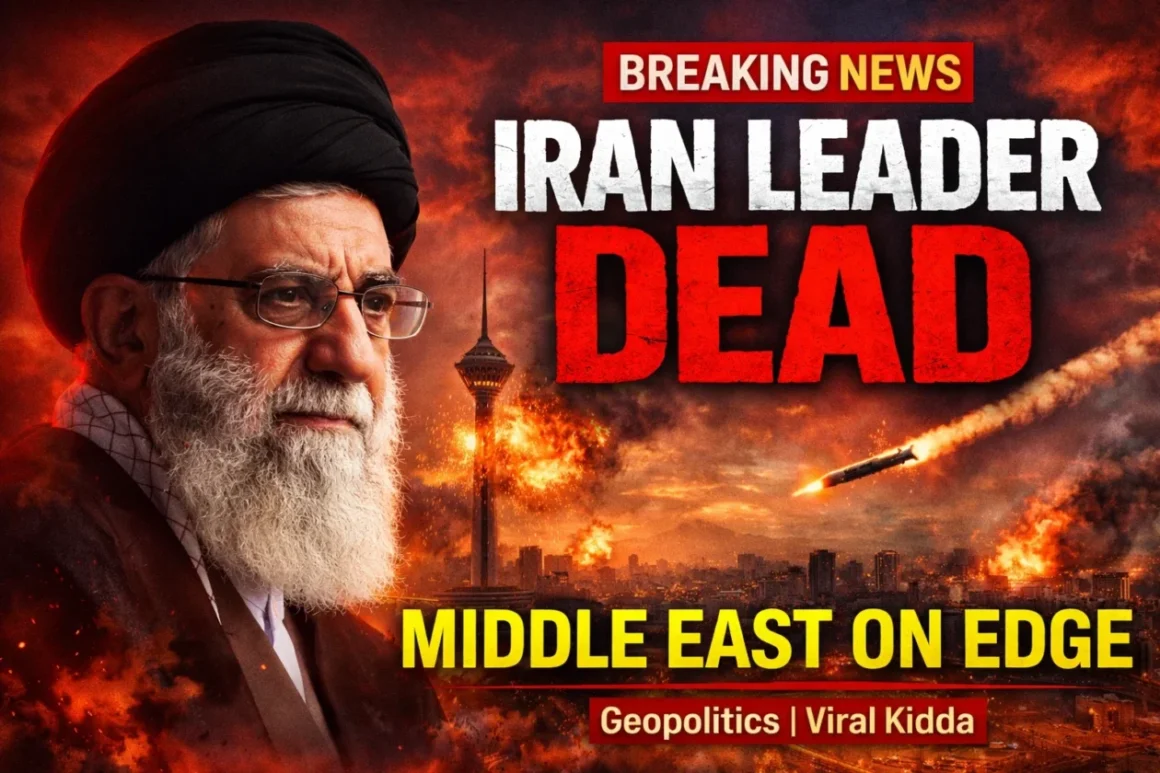
28 February 2026, the geopolitical balance of the Middle East changed dramatically when Iran’s Supreme Leader Ayatollah Ali Khamenei was killed during coordinated United States–Israel airstrikes targeting Tehran.
Iranian state media officially confirmed the death on 1 March 2026, followed immediately by a 40-day national mourning declaration.
International agencies including Reuters, AP News, and Time reported that the strike was part of a wider military campaign aimed at dismantling Iran’s nuclear and command infrastructure.
This was not merely an assassination.
It was a decapitation strike, designed to remove Iran’s ideological and military command simultaneously.
Timeline: How the Crisis Started (December Escalation → February Strike)
Phase 1 : December 2025: Silent Escalation
By late 2025, intelligence reports indicated:
- Iranian proxy attacks increasing across Iraq & Syria
- Maritime threats near Strait of Hormuz
- Cyber disruptions targeting Western infrastructure
- Oil shipment intimidation operations
Western analysts called this period a “low-intensity shadow war.”
Sanctions pressure caused:
- Currency collapse
- Fuel shortages
- Internet slowdowns
- Growing public unrest
Iran’s internally entered what analysts described as controlled instability.
Phase 2 : Internal Crisis Inside Iran
Before the strike, Iran’s was already facing:
- Economic collapse
- Youth protests
- Power blackouts
- Communication restrictions
Reports suggest authorities deployed “White SIM” networks — restricted telecom SIM cards allowing only government-approved communication during unrest.
These systems are typically activated during:
- regime instability
- protest waves
- military emergencies
Public dissatisfaction had intensified after previous protest crackdowns that killed thousands, according to Western assessments.
Phase 3 : US–Israel Strategic Alignment
Diplomatic talks between Iran and Western nations collapsed over uranium enrichment disputes.
On February 28, 2026, Israel — reportedly supported by U.S. intelligence — launched precision strikes across Tehran.
Satellite imagery later showed severe destruction at leadership compounds.
Targets reportedly included:
- Supreme Leader compound
- Defense Council meeting
- IRGC leadership hubs
- Military command infrastructure
Multiple senior officials were killed alongside Khamenei.
Operation “Epic Fury” — The Strike
According to international reporting:
- Israeli aircraft executed coordinated bombardment
- U.S. intelligence helped locate leadership gathering
- Simultaneous strikes ensured command collapse
The operation eliminated dozens of senior Iranian figures and created the largest leadership vacuum since the 1979 Islamic Revolution.
Explosions were reported across Tehran while air defense systems failed to intercept several incoming strikes. THE GUARDIAN
Why Target Khamenei?
Khamenei ruled Iran’s since 1989, shaping:
- Anti-Israel doctrine
- Anti-US foreign policy
- Regional proxy warfare networks
He maintained influence through alliances with Hezbollah, Hamas, and regional militias.
Western strategic thinking believed:
- Removing him could weaken ideological unity
- Fragment IRGC loyalty
- Force nuclear negotiation reset
However, early intelligence now suggests regime collapse is unlikely immediately.
Power Vacuum: Who Controls Iran Now?
After the assassination, Iran formed an interim leadership council, including:
- President Masoud Pezeshkian
- Chief Justice Mohseni-Ejei
- Cleric Alireza Arafi
This council governs until a new Supreme Leader is selected.
The Islamic Revolutionary Guard Corps (IRGC) remains the real power broker.
Meaning:
Iran’s did not collapse — it militarized.
Internal Iranian Reaction
Reactions inside Iran are deeply divided.
State Response
- Massive mourning rallies
- Khamenei declared martyr
- Security crackdowns intensified
Public Reaction
Some citizens reportedly celebrated quietly, while others feared chaos and retaliation.
Supermarkets emptied.
Highways jammed.
Internet disruptions increased nationwide.
Iran entered psychological uncertainty.
Regional Explosion: Immediate Fallout
The assassination triggered global instability:
- Missile alerts in Israel
- Gulf military mobilization
- Oil market volatility
- Airspace closures
Pro-Iran’s protests erupted internationally, including violent demonstrations targeting U.S. diplomatic sites in Pakistan.
The Middle East moved dangerously close to regional war.
US & Iran: Long History of Interference
The 2026 strike cannot be understood without history.
Major flashpoints include:
- 1953 CIA-backed Iranian coup
- 1979 Islamic Revolution
- Iran-Iraq War influence
- Nuclear sanctions era
- 2020 killing of Qasem Soleimani
Iran views Western actions as regime interference.
The U.S. frames actions as nuclear containment.
This ideological clash defines modern geopolitics.
Why Israel Supported the Strike
Israel’s strategic concerns include:
- Iranian nuclear capability
- Missile programs
- Proxy forces near borders
Israeli leadership long warned Iran represented an existential threat.
Analysts say eliminating Khamenei aimed to:
- Delay nuclear development
- Break command chains
- Reduce coordinated proxy warfare
But critics argue it risks long-term escalation.
Global Geopolitical Impact
Energy Markets
Strait of Hormuz instability threatens ~20% of global oil supply.
Russia & China
Both nations condemned Western intervention, signaling deeper geopolitical bloc formation.
Global South
Many neutral nations urged de-escalation.
The world increasingly resembles multi-polar confrontation politics.
Geopolitical Surveys & Analyst Consensus
Current intelligence assessments suggest:
- Regime survival probability: HIGH
- Regional retaliation risk: VERY HIGH
- Nuclear escalation risk: MODERATE–HIGH
Khamenei’s death removed a leader — not the system.
The Beginning of a New Middle East Era?
The killing of Iran’s Supreme Leader represents:
- First assassination of a sitting supreme ideological ruler by foreign powers in decades
- Direct US-Israel military coordination inside Iran
- Transition from proxy conflict to open confrontation
The Middle East has entered what analysts call:
“Post-Deterrence Geopolitics.”
Where leadership itself becomes a battlefield target stay tuned for next update with geopolitics viral kidda.
Conclusion
Ayatollah Ali Khamenei’s death marks one of the most consequential geopolitical events of the 21st century.
It was not just an airstrike.
It was a signal:
- Power structures are changing
- Regional wars are evolving
- Global alliances are hardening
Whether this leads to peace, escalation, or regime transformation will define the next decade of international politics.
Disclaimer
This article is based on publicly available international reporting, intelligence analysis, and geopolitical assessments. Events remain fluid and continue to evolve.