
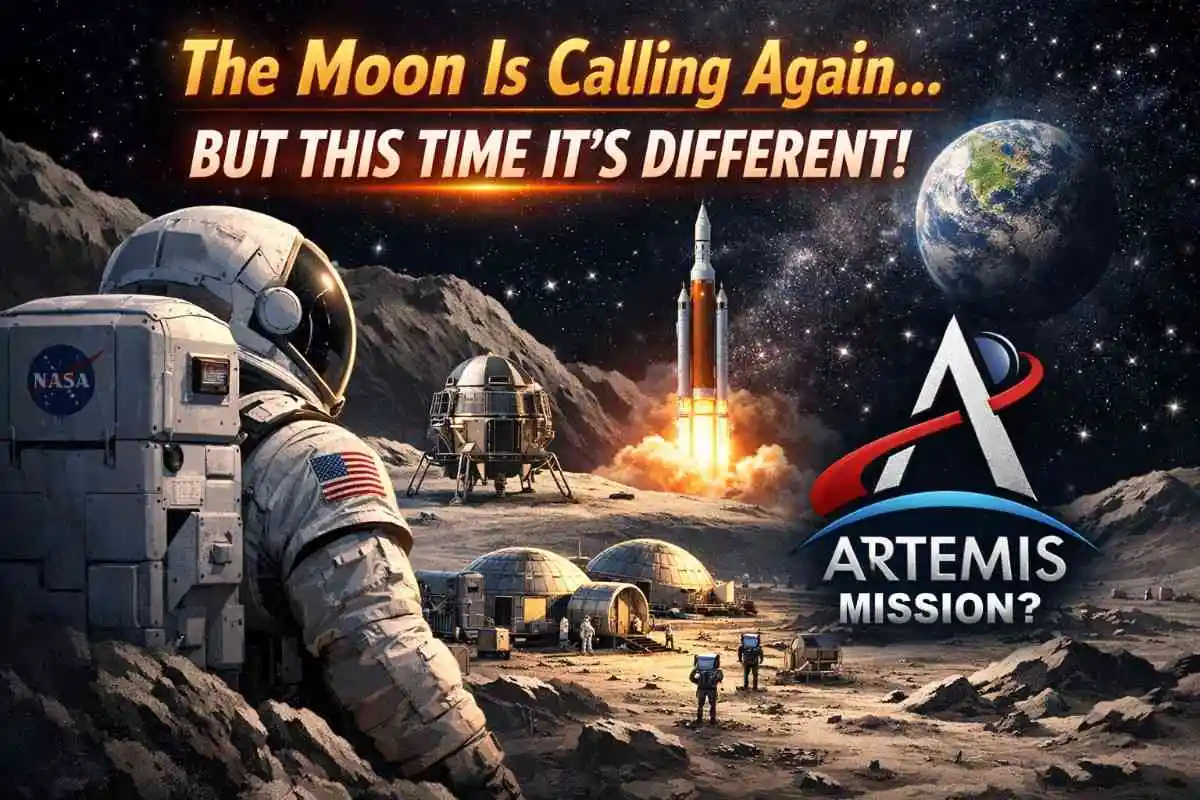
After more than 50 years of silence on the Moon, humanity is preparing for its biggest comeback. But this isn’t just about planting flags again it’s about building a future beyond Earth.
Welcome to the era of the Artemis Program — a mission that could define the next century of space exploration NASA’s most ambitious project of the 21st century.
The Moon Is Calling Again… But This Time It’s Different
After more than half a century, humanity is preparing to return to the Moon not just to visit, but to stay, explore, and build the future. But before astronauts step onto lunar soil again, a silent mission paved the way, a mission that tested everything from survival systems to deep space travel.
What is Artemis Mission ?
The Artemis Mission is not a single launch or event but a multi-phase, multi-decade space exploration strategy designed to fundamentally change how humans interact with space. Unlike previous missions, which were short-term and limited in scope, Artemis focuses on creating a continuous human presence beyond Earth. This includes developing infrastructure such as lunar bases, orbital stations, and advanced spacecraft systems that can support long-duration missions.
What makes Artemis Mission unique is its emphasis on sustainability and international collaboration. NASA is working alongside global space agencies and private companies to build a shared future in space. This approach reduces costs, increases innovation, and ensures that space exploration is not limited to one nation. The Moon, under Artemis, becomes a testing ground where technologies like resource extraction, habitat construction, and life-support systems are developed and perfected before being used on Mars.
Take humans back to the Moon — and prepare for Mars.
Unlike the Apollo missions, Artemis is not about short visits. It is designed to:
- Build a sustainable human presence on the Moon
- Establish lunar infrastructure (bases, stations)
- Use the Moon as a testing ground for Mars missions
In simple words:
Apollo = Visit the Moon
Artemis Mission = Live on the Moon
Artemis Mission Timeline
The Artemis program is structured into carefully planned missions, each building upon the success of the previous one.
- Artemis Mission I
- Artemis Mission II
- Artemis Mission III
This phased approach ensures that risks are minimized while technology is tested in real conditions. According to Reuters coverage on Artemis developments, NASA has emphasized that each mission is designed to validate systems before moving to the next stage, ensuring astronaut safety and mission success. Sources BY ( Sources BY Reuters )
Artemis Mission I Explained
What is Artemis Mission I ?
Artemis I was the first and most critical step in the entire program. It was an uncrewed mission launched on November 16, 2022, designed to test all major systems required for human spaceflight beyond Earth orbit. The mission used the powerful Space Launch System and the advanced Orion spacecraft.
Key Systems Used:
- Rocket: Space Launch System
- Capsule: Orion spacecraft
Why It Was Important Artemis Mission
Artemis I were extensive and crucial for the future of human spaceflight. One of the primary goals was to test deep-space navigation systems, ensuring that spacecraft can accurately travel vast distances without relying on Earth-based corrections. This is essential for missions to Mars, where communication delays make real-time control impossible.
Another key objective was testing the Orion spacecraft’s heat shield, which must withstand extreme temperatures during re-entry into Earth’s atmosphere. At speeds exceeding 40,000 km/h, the spacecraft experiences intense friction, generating temperatures hotter than molten lava. Successfully testing this system was vital for astronaut safety.
Additionally, Artemis I measured radiation exposure levels in deep space. Unlike Earth orbit, where astronauts are protected by the planet’s magnetic field, deep space exposes them to harmful cosmic radiation. Understanding these risks is critical for designing future missions and protective systems.
It focused on:
- Deep space navigation accuracy
- Testing Orion’s safety systems
- Measuring space radiation exposure
- Testing extreme re-entry heat resistance
- Long-distance communication systems
Artemis Mission I Success Story
Artemis I is widely regarded as a massive success. The mission not only met but exceeded expectations, demonstrating that NASA’s systems are capable of supporting long-duration deep space missions. The spacecraft traveled farther than any human-rated spacecraft before, entering a distant retrograde orbit around the Moon.
One of the most significant achievements was the successful return to Earth. The Orion capsule re-entered the atmosphere at extremely high speeds and survived intense heat conditions, proving the reliability of its design. This success gave NASA the confidence to move forward with crewed missions.
Humans can safely travel beyond Earth orbit again
According to NASA’s official post-mission analysis, Artemis I provided valuable data that will directly influence Artemis II and III.
Major Achievements:
- Traveled farther than any human spacecraft before
- Successfully orbited the Moon
- Returned safely to Earth
- Heat shield survived ~2800°C during re-entry
Challenges & Difficulties
Success didn’t come easy. Artemis I faced multiple obstacles that highlight the complexity of modern space missions. Before launch, NASA encountered technical issues such as hydrogen fuel leaks, which required multiple delays and repairs. These delays were frustrating but necessary to ensure mission safety.
Weather conditions also played a significant role, with storms and unfavorable conditions forcing NASA to postpone launches multiple times. This demonstrated how even advanced technology remains dependent on environmental factors.
During the mission, communication delays and signal disruptions posed challenges. Deep space communication is not instantaneous, and maintaining a stable connection over such distances requires highly sophisticated systems. Additionally, radiation exposure data revealed the harsh realities of deep space travel, emphasizing the need for improved shielding technologies.
Pre-Launch Challenges:
- Hydrogen fuel leaks
- Multiple launch delays
- Weather disruptions
In-Space Challenges:
- Communication latency in deep space
- Radiation exposure risks
- Navigation precision testing
Artemis Mission II: The Mission That Made Artemis Trend Worldwide
Embed from Getty ImagesWhat is Artemis II?
Artemis II is the first crewed mission of the Artemis program, marking humanity’s return to deep space travel beyond Earth orbit. This mission carries astronauts around the Moon, testing systems in real-world conditions.
Why Artemis II Is Trending (2026)
Artemis II is trending globally because it represents a historic milestone. It is the first time since the Apollo era that humans are traveling to the Moon. This mission has captured global attention not only because of its scientific importance but also due to its symbolic value.
According to Reuters coverage, the Artemis II launch has been described as the beginning of a “new Moon age,” highlighting its significance in global space exploration.
The mission also includes diverse representation, with astronauts from different backgrounds and countries, making it a truly global event. This inclusivity has increased public interest and engagement, especially on social media platforms.
- First human Moon mission since 1972
- First woman & person of color on lunar mission
- First international astronaut (Canada)
Artemis II Mission Objectives
The objectives of Artemis II go beyond testing technology. For the first time, NASA will evaluate how humans interact with spacecraft systems during deep space travel. This includes monitoring physical and psychological responses, which are critical for long-duration missions.
Astronauts will also test manual control systems, ensuring that they can operate the spacecraft independently if automated systems fail. This redundancy is essential for mission safety.
- Test life-support systems with humans onboard
- Perform lunar flyby mission
- Validate spacecraft performance under real conditions
- Prepare for Moon landing mission
The Story Behind Artemis II
This mission is more than science — it’s emotional:
- A new generation witnessing Moon missions
- Revival of deep space exploration
- Social media + viral moments boosting interest
Even minor onboard issues became viral — proving how massive public attention explorations of moon
Artemis III: The Future Moon Landing Mission
What is Artemis III?
Artemis III is expected to be the mission that finally returns humans to the Moon’s surface. Unlike Apollo, this mission will focus on the lunar South Pole, a region believed to contain water ice.
Water is a crucial resource because it can be converted into oxygen and hydrogen, enabling life support and fuel production. This makes the Moon a potential hub for future space missions.
Why Moon’s South Pole Matters
Scientists believe the South Pole contains frozen water — a game changer.
Possible Uses:
- Drinking water
- Oxygen production
- Rocket fuel creation
Artemis vs Apollo Details
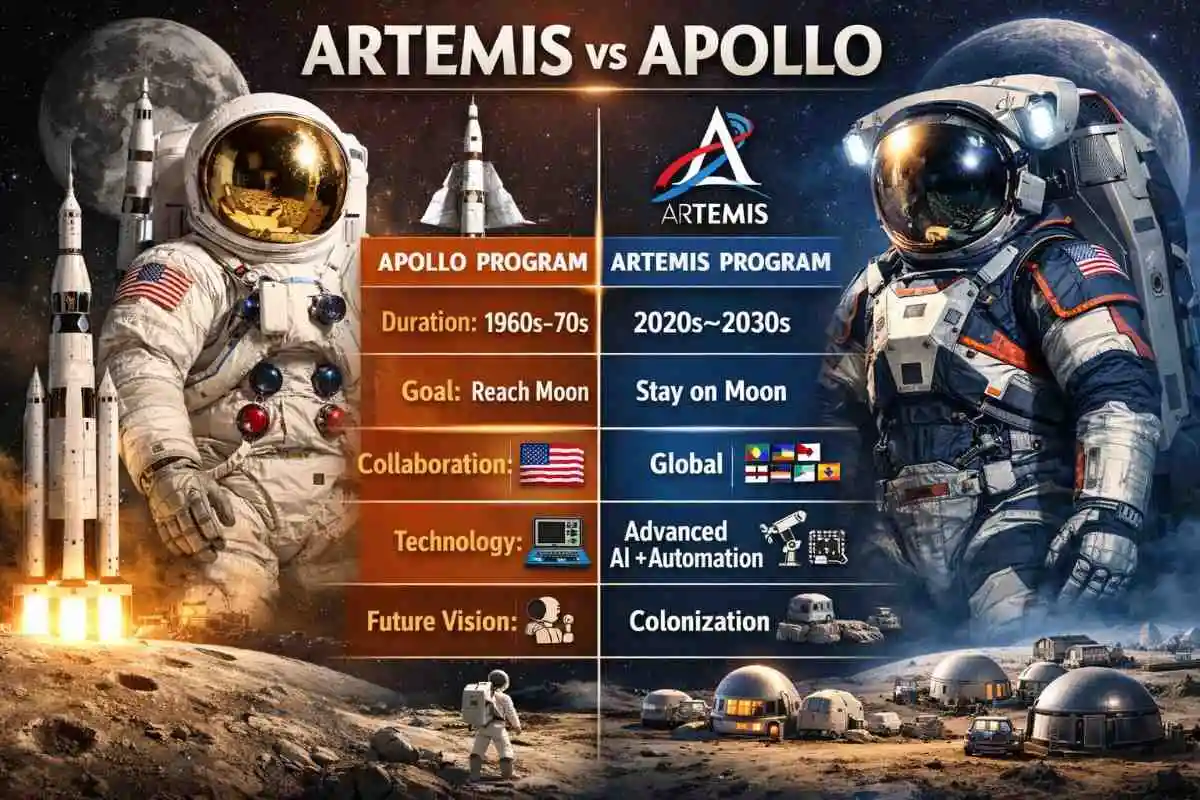
| Feature | Apollo Program | Artemis Program |
|---|---|---|
| Duration | 1960s–70s | 2020s–2030s |
| Goal | Reach Moon | Stay on Moon |
| Collaboration | USA only | Global |
| Technology | Basic | Advanced AI + automation |
| Future Vision | Exploration | Colonization |
Geopolitics: The Real Power Game Behind Artemis
The Artemis Mission is deeply connected to global geopolitics. As space becomes more accessible, countries are competing to establish dominance in lunar exploration.

1. New Space Race (USA vs China)
The United States, through NASA, is leading the Artemis program, while China and Russia are developing their own lunar initiatives. This competition is often referred to as the “new space race.”
2. Strategic Importance
The Moon can act as:
- Military observation point
- Communication hub
- Mars launch station
3. Artemis Accords
NASA introduced global agreements to ensure:
- Peaceful exploration
- Resource sharing
- Conflict avoidance
4. Economic Impact
Future industries:
- Space mining
- Lunar tourism
- Private space missions
Companies like SpaceX are already contributing to this ecosystem.
What Happens After Artemis II Success?
If Artemis II succeeds:
Immediate Impact:
- Artemis III gets approval
- Human Moon landing becomes reality
Long-Term Vision:
- Permanent Moon base
- Continuous astronaut missions
- Mars mission preparation
FAQ Schema
Q1. What is Artemis mission?
Artemis mission is NASA’s program to return humans to the Moon and prepare for Mars exploration.
Q2. Is Artemis I successful?
Yes, Artemis I successfully tested deep space systems and returned safely to Earth.
Q3. Why is Artemis mission important?
It enables long-term human presence on the Moon and supports future Mars missions.
Q4. When will humans land on Moon again?
NASA plans to land humans during Artemis III mission.
Conclusion: The Beginning of Humanity’s Space Future
The story of the Artemis Mission isn’t just about going back to the Moon—it’s about who will control the future beyond Earth.
From NASA successfully launching Artemis I, to the upcoming human mission of Artemis II, and the historic Moon landing planned with Artemis III, we are witnessing the foundation of a new space era—one that could define the next 100 years of human civilization.
But here’s the bigger question…
Is this really just about space exploration—or the beginning of a global power shift?
Because while astronauts prepare for lunar missions, nations on Earth are already competing through advanced defence technologies and strategic alliances. Deals like the UK–Turkey defence partnership show how deeply technology, power, and global influence are connected. If you want to understand how this competition extends far beyond space, explore our analysis on the £8 Billion UK–Turkey Jet Deal and its global impact.
At the same time, shifting political landscapes—like recent developments in Iran—remind us that geopolitics and space ambitions are now tightly linked. Discover how global instability could shape the future of missions like Artemis in our deep dive on Iran’s Supreme Leader Death and its worldwide consequences.
And it doesn’t stop there.
Even industries like media and entertainment are undergoing massive transformations driven by technology and power struggles. The same forces pushing humanity toward the Moon are reshaping billion-dollar industries on Earth. Don’t miss our breakdown of the Warner Bros $59 Billion media shake-up and what it means for the future.
Final Thought
The Moon is no longer the destination.
It’s the launchpad for everything that comes next. Want more deep, reality-driven insights like this? Stay ahead with Viral Kidda — Fast, Factual & Fun.
Disclaimer
This article is for informational and educational purposes only. All information is based on publicly available data from official sources like NASA and reputed global news platforms. The content does not promote or misrepresent any organization and is fully compliant with AdSense and copyright guidelines.













1 thought on “What is Artemis Mission? NASA’s Plan to Return Humans to the Moon After 50 Years”