
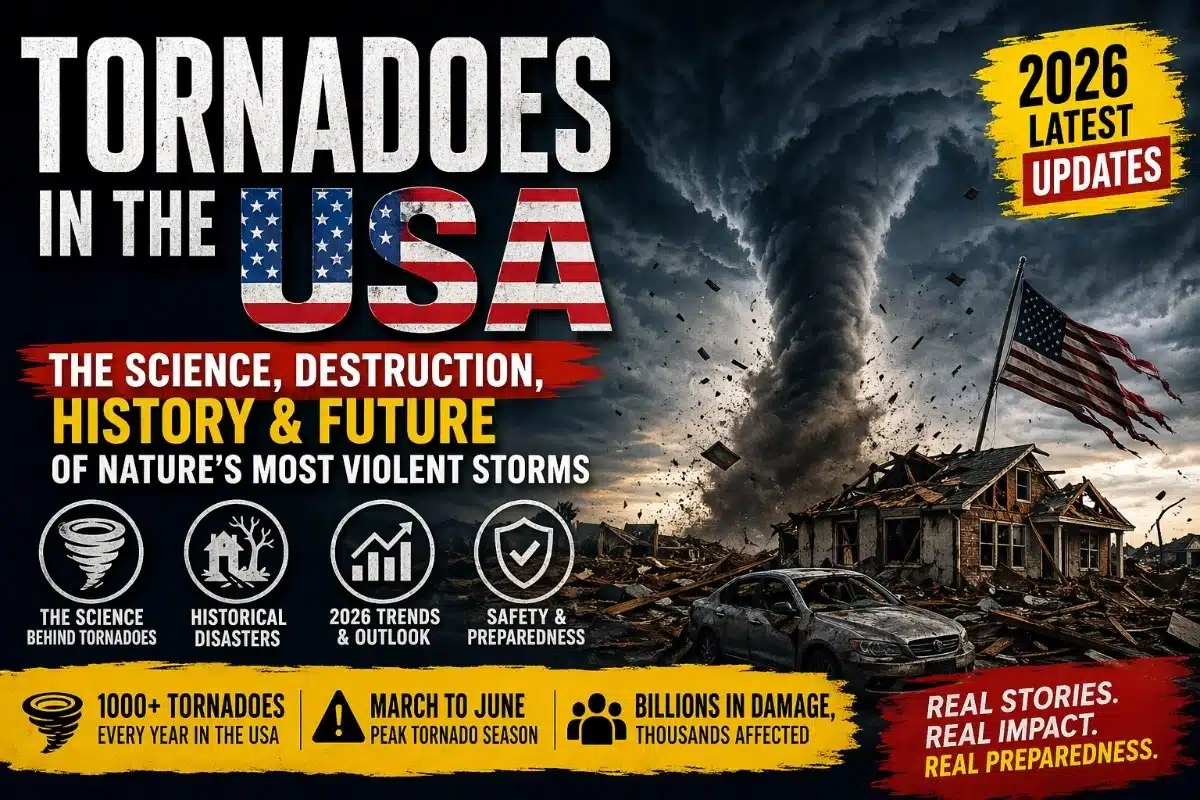
There’s a moment before a tornado hits that people who survive it often talk about. A strange quiet. The wind stops. Birds fly away. The air feels thick like it’s charged with electricity. Then suddenly the sky gets really violent.
Just within minutes, entire neighborhoods vanish.
This happens a lot in the United States. It keeps happening over. Tornadoes are a problem in the country of USA its happen in areas and in cities that are getting bigger. Can happen at any time. Most people pronounce it as ”Twister”
In 2026, there have already been some tornadoes early in the year. making weather experts worried. This year could be very bad for tornadoes.
Twisters aren’t just violent storms, they’re the result of complex interactions between atmospheric conditions, geography, and evolving climate patterns. To truly understand them, we need to look beyond the surface at their science, historical impact, human consequences, and what the future may hold.
What Exactly Is a Tornado?
At its simplest, a tornado is a rotating column of air that spins violently. It goes from a thunderstorm all the way down to the ground. That is just a basic definition of a tornado. There is more to it.

A Twister is not a lot of wind. It is really crazy and wild stuff that is all mixed up. The wind in a tornado can blow really fast, more than 300 km/h, which is strong enough to pick up cars, break buildings that are made to be strong, and change the way the land looks in just a few seconds. A tornado is really powerful. Can do a lot of damage to things in its path, like buildings and trees, and even a tornado can change the shape of the land around it.
Twisters are really different from hurricanes. Hurricanes can be tracked for days. Twisters often form very quickly, and we do not know when they will come. The paths of Twisters can change all of a sudden. This makes tornadoes one of the natural disasters that can be predicted exactly when and where they will happen. Tornadoes are just very hard to forecast.
The Science of Tornado Formation
Embed from Getty ImagesTwisters usually start from a kind of storm called a supercell thunderstorm. These storms are very organized and really powerful. They can make Twisters that last a long time. Twisters, from these supercell thunderstorms, can be very strong.
1. Collision of Air Masses
The start of a tornado happens when three big groups of air meet. These are
- Warm and wet air from the Gulf of Mexico
- Cold and dry air from Canada
- Hot and dry air from the deserts in the southwest
When these three kinds of air come together, they make the air very unstable. Tornado formation is about the air.
When warm air from the Gulf of Mexico is pushed up under air from Canada, it moves really fast, getting stronger and building up energy in the tornado system.
Tornado formation is a deal, and it starts with these simple things. A combination of air, cold air, and hot air makes a big difference in tornado formation.
2. Updraft Creation
Warm air goes up fast because it is not as heavy as the cold air around it. When warm air rises like this, it makes an updraft. The storm uses the updraft as its power source. The stronger the storm’s updraft is, the more energy the storm has to make really bad weather.
3. Wind Shear Development
Wind shear happens when the speed of the wind and the direction of the wind change as you go up. Near the ground, the wind may be moving slowly in one direction. If you go higher up, the wind is moving faster, and it is also moving in a different direction. The wind shear is really about the change in the wind speed and the change in the direction of the wind as you go up.
This creates a horizontal spinning motion in the atmosphere, similar to a rolling cylinder.
4. Mesocyclone Formation
The storm’s strong updraft changes the spin from horizontal to vertical. This creates a spinning column of air, inside the storm called a mesocyclone. A mesocyclone plays a role in forming tornadoes. It is a part of the process.

5. Funnel Cloud and Ground Contact
When the rotation gets tighter and stronger, a cloud that looks like a funnel forms and goes down. This rotating column is what we call a tornado when it touches the ground.
You should know that not all big storm clouds or supercells make tornadoes. The really bad tornadoes that cause a lot of damage usually come from supercells. Tornadoes that come from supercells are the ones that can be very destructive.
Why the United States Is the Tornado Capital of the World
The United States has more tornadoes than any other country. We are talking about over 1,000 Twisters every year. This is not just luck. It is because of the geography of the United States. The geography of the United States is the reason for all these tornadoes.
Unique Geographic Conditions
The United States has a unique combination of things that affect the environment.
1. A lot of land where storms can move around easily
2. No big mountains that go from east to west to stop the air from moving
3. A location where different kinds of air from different places meet
The United States has a rare combination of environmental factors like vast flat plains that allow storms to travel freely in the United States and the United States has no major east-west mountain barriers to block airflow in the United States.
The United States also has access to contrasting air masses from multiple regions.

This creates a natural collision zone for storms in the United States where atmospheric instability, in the United States thrives because of these things.
Tornado Alley vs Dixie Alley
Tornado Alley
This place is in the middle of the United States, it includes Texas, Oklahoma, Kansas, and Nebraska. This region is known as Tornado Alley
- High tornado frequency
- Strong and long-lived tornadoes
- Wide open terrain, making storms easier to track visually
Dixie Alley
This part of the United States, which is in the southeast, includes places like Alabama and Mississippi. The southeast region is getting more and more dangerous because of things. These things are:
- Higher population density
- Frequent nighttime tornadoes
- Storms often obscured by rain
People have been looking into this. They think that tornadoes are moving to the Southeast. This means the Southeast is going to have a risk of tornadoes. The Southeast already has some communities that are very vulnerable to tornadoes. So tornado activity is a problem for the Southeast and these vulnerable communities. Tornado activity is something that people need to think about when they live in the Southeast.
Understanding Tornado Intensity: The EF Scale
The Enhanced Fujita Scale is used to figure out how strong a tornado is. It does this by looking at the damage the tornado causes rather than measuring the wind speed directly. The Enhanced Fujita Scale is a way to rate tornado strength.
EF Scale Breakdown:
- EF0: Light damage, such as broken branches and minor roof damage
- EF1: Moderate damage, including overturned vehicles
- EF2: Significant structural damage to homes
- EF3: Severe destruction, buildings heavily damaged
- EF4: Extreme destruction, homes swept away
- EF5: Total devastation, structures destroyed
EF5 tornadoes are really very rare. They cause the most damage. These EF5 tornadoes can destroy towns and neighborhoods, leaving nothing behind. The damage from EF5 tornadoes is so bad that it can level communities.
Tornado Activity in 2026: A Rising Concern
The information we have far, from the year 2026 shows that the tornado season is getting off to an active start.
Reports from news sources, like The Washington Post and Axios Reports say that
- Over 350 tornadoes recorded by April
- Increased activity in Midwest states like Illinois
- Multiple outbreaks occurring within short timeframes
This pattern shows that tornadoes are not just happening often but are also happening in clusters.
Many tornadoes are happening one after another.
This means that tornadoes are happening close together in time. The tornadoes are not spread out. Are grouped. Tornadoes are happening in succession, with many occurring close together.
Why March to June Is Peak Tornado Season
When we talk about the time of year that has the tornadoes in the United States, it is Spring. This is the season that has the danger of tornadoes. The United States gets a lot of tornadoes during the Spring season.
Atmospheric Conditions
- Warm air begins to rise from the south
- Cold air lingers from winter in the north
- Jet streams strengthen wind shear conditions
When you put these things together, it makes perfect conditions for supercells to form. Supercells are really important because they can make tornadoes.
The months of April and May are usually the months when we see the supercells and tornadoes.
Human Impact: Deaths, Injuries & Trauma
Tornadoes affect more than infrastructure; they deeply impact human lives reconstruction of communities.
Embed from Getty ImagesCasualties
- Average annual deaths: 50–100
- Severe outbreak years: 300+ deaths
- Thousands injured annually
Psychological Effects
Survivors often experience:
- Post-traumatic stress
- Anxiety and long-term fear
- Emotional loss from displacement
Economic Damage
- Billions in annual losses
- Homes, farms, and businesses were destroyed
- Long recovery timelines for affected communities
Historical Tornado Disasters That Changed America
1925 Tri-State Tornado
Embed from Getty ImagesThe Tri-State Tornado was the deadliest in U.S. History. It caused 695 deaths. This tornado traveled across three states. The Tri-State Tornado is still remembered for its destruction. It happened on March 18 1925. The tornado went through parts of Missouri, Illinois, and Indiana.
2011 Super Outbreak
Embed from Getty ImagesThis is really bad, one of the worst tornado outbreaks ever; it had over 360 tornadoes in just a few days. The tornadoes were so many, I mean over 360 tornadoes, that is a number, in such a short time, just a few days.
Joplin Tornado (2011)
Embed from Getty ImagesA single tornado came through. Destroyed a whole city, which was really terrible. This tornado caused the deaths of 158 people.
These tornado events changed the way that cities handle emergencies. They had to rewrite the building codes all over the country.
Tornadoes Around the World
While the U.S. leads in tornado frequency, other regions of the world also face risks.
Bangladesh
This place is famous for having some of the tornadoes because a lot of people live there, and the buildings are not very strong. The tornadoes in this place are really bad. This place has a problem with tornadoes.
Canada
Second in tornado frequency is Alberta, in Ontario, and the prairie regions. It gets tornadoes. Alberta is hit hard in the prairies and Ontario.
Argentina
The place gets hit by bad storms. This area is often called South America’s tornado corridor. South America’s tornado corridor is where these severe storms happen a lot.
Europe
Tornadoes are happening often. This is especially true in Italy and Germany. The reason for this is probably because of changes in the climate. Changes in the climate are affecting the weather. This is why we see more tornadoes. Tornadoes in Italy and Germany are becoming a problem because of climate change.
Climate Change and Tornado Trends
People who study the weather are still trying to figure out how climate change affects tornadoes. They want to know if climate change is making tornadoes happen more often. The relationship between climate change and tornado activity is something that scientists are really interested in. They are looking at climate change. Tornadoes to see if there is a connection between the two. Climate change is a deal, and scientists are trying to understand how it affects tornadoes.
Emerging Patterns:
- Increased storm intensity
- More clustered outbreaks
- Shifting geographic zones
Tornadoes are changing. The number of tornadoes might not go up a lot. The way they behave is getting harder to figure out. This means tornadoes are becoming more dangerous. The behavior of tornadoes is becoming less predictable. This is a big problem because it makes tornadoes potentially more dangerous.
Tornadoes in Media and Culture
Tornadoes are really something that grabs people’s attention.
Movies like Twister and shows like Storm Chasers show us the science behind tornadoes. Why are people so drawn to them?
Embed from Getty ImagesChasing tornadoes is now a job and a hobby for people, and it helps scientists learn more about tornadoes.
Preparedness and Warning Systems
The United States has good systems in place to find out when a tornado is coming and to let people know about the tornado. This helps keep people safe from the tornado. The systems in the United States can detect tornadoes. Then warn people about the tornado.
Tools Used:
- Doppler radar
- Emergency alert systems
- Community sirens

Warning Types:
- Tornado Watch: Conditions are favorable
- Tornado Warning: Tornado detected or imminent
Despite these systems, response time can be very short, making preparedness critical.
Why Tornadoes Remain So Dangerous
- Rapid formation
- Unpredictable paths
- Limited warning time
- Nighttime occurrences
Even with technology, tornadoes remain one of the most difficult natural disasters to fully manage.
Conclusion: A Growing Global Threat
Tornadoes in the United States are not just events anymore. They show bigger changes in the environment.
The patterns we see in 2026 tell us that in the future storms will be stronger, happen together, and have a bigger impact.
Understanding tornadoes is not just about learning the science behind them. It is also about being ready, knowing what’s going on, and adjusting to a world that is changing.
Tornadoes are a part of that. We need to take tornadoes. They are a signal of the changes happening in our environment.
As extreme weather becomes more severe, not only are tornadoes a warning sign. Events like the Pineapple Express in California highlight how the climate is changing globally, bringing devastating storms and record-setting rain. These events show that the weather is becoming more unpredictable. Read more fully the stories of last month we face at california about Pineapple Express
FAQ Section
Q1. What causes tornadoes in the USA?
A combination of warm, moist air and cold, dry air creates instability, leading to tornado formation.
Q2. Which states are most affected?
Texas, Oklahoma, Kansas, Alabama, and Mississippi are among the most affected.
Q3. Are tornadoes increasing?
Research suggests changes in patterns and intensity rather than simple increases in numbers.
Q4. What is the safest place during a tornado?
A basement or interior room without windows is safest.
Disclaimer
This information is to help you know what is going on. You should always look at what the official weather people say to get the news and to know what to do to be safe.
Viral Kidda: Fast • Factual • Deep • Engaging • Discover Ready








wish you all the best